Ponding on Flat Roofs: Causes, Risks and Potential Fixes
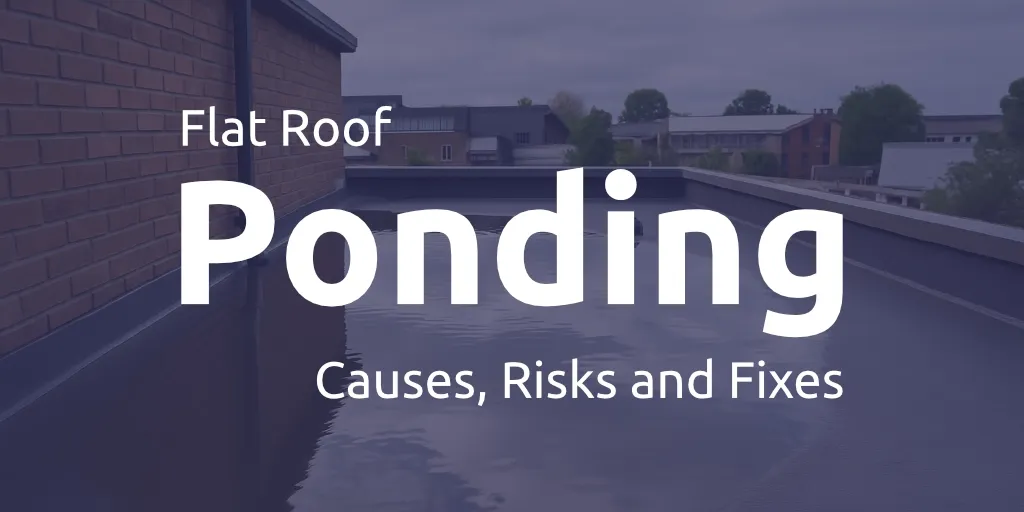
Ponding water refers to rainwater that remains on a flat or low-slope roof for longer than 48 hours after rainfall has stopped. It is a common issue across the UK, especially on ageing buildings or those with drainage shortcomings. While some surface water immediately after rain is expected, water that lingers can signal underlying problems with roof design or construction.
Despite their name, flat roofs are never entirely flat and are designed with subtle gradients to encourage rainwater to flow towards drains or outlets. When these gradients are poorly built into the roof, interrupted by obstructions, or weakened over time by structural movement, water begins to collect in shallow depressions. Given the UK’s frequent rainfall and damp climate, even minor drainage problems can quickly escalate. Ponding is not just an inconvenience, it’s one of the most common causes of premature roof failure.
What Causes Ponding on Flat Roofs?
There are several reasons ponding may occur, and in many cases, it results from a combination of factors. One of the most common causes is insufficient or incorrectly installed drainage. According to BS 6229:2018, flat roofs should be constructed with a design fall of 1:40, which allows for a minimum of 1:80 in service. This margin accounts for construction tolerances and long-term deflection however on many older buildings or retrofit projects, the original design may not have included adequate falls, or they may have been lost through multiple overlay systems.
Deflection in the roof deck is another significant contributor. Timber joists, steel supports, or concrete slabs can all begin to sag under the weight of constant loading, especially if the insulation beneath the membrane becomes saturated. Once these depressions form, they naturally collect water and create areas where ponding will continue unless the roof is levelled or reprofiled.
Poorly positioned or elevated outlets or trims can also cause water to remain trapped. This is particularly common when outlets are placed near structural walls or columns, which may create a high point relative to the centre of the roof span. Even slight discrepancies in height between the outlet and the surrounding surface can prevent effective drainage. The same is true when detailing laps or protective collars around the outlet lift it above the surrounding roof finish.
Interruptions to drainage patterns are also a frequent source of problems. Roof features such as skylights, plant upstands, or parapet walls can create zones where water flow is blocked or redirected. Unless these areas include crickets or sloping details to guide water around them, they often become points of persistent ponding. Cross-falls between roof sections can create valleys where the effective gradient is shallower than intended, further slowing the movement of water.
Debris, leaf matter, and silt can obstruct outlets and cause backups. This is especially likely in buildings close to trees or in areas where maintenance has been neglected. During construction, temporary blockages are sometimes created to protect workers or lower levels from water discharge, and these can be forgotten once the roof is complete.
Why Ponding Water is an Issue
Ponding is not only a symptom of poor drainage but a direct contributor to long-term damage. The British Standard makes clear that water should not remain on the surface of a flat roof beyond 48 hours. The longer it sits, the more likely it is to cause deterioration to the waterproofing system and the layers beneath.
Prolonged exposure to standing water increases the risk of membrane degradation. Water magnifies UV exposure and promotes algae growth, both of which accelerate wear. Bituminous felt, PVC membranes, and even high-performance single-ply systems will eventually degrade if submerged for long periods. Any punctures or defects that occur in ponded areas allow water to enter more rapidly, as the weight of standing water creates pressure that drives moisture into the roof build-up.
Once water penetrates the membrane, it can saturate the insulation layer. Wet insulation loses its thermal performance and can trap moisture against the structural deck, encouraging rot, mould growth, or corrosion, depending on the construction materials. In many cases, saturated insulation must be fully removed and replaced, making repairs significantly more expensive and disruptive.
The weight of ponding water also places an extra load on the roof structure. Even shallow pools can add considerable weight, particularly on large commercial roofs. This can deepen the initial deflection, worsening the drainage problem and creating a cycle of increasing damage.
During cold weather, ponding can freeze, increasing the brittleness of roofing membranes. As other parts of the roof expand and contract with temperature changes, frozen areas remain rigid, creating stress that may force laps apart or split seams. This makes roofs particularly vulnerable in the late winter and early spring when freeze-thaw cycles are most active.
Finally, ponding creates safety hazards. Wet areas can promote moss and algae growth, which can make surfaces slippery for maintenance teams. If the water freezes, this risk increases further, particularly on roofs with plant equipment or designated access routes.
How to Resolve Ponding Issues
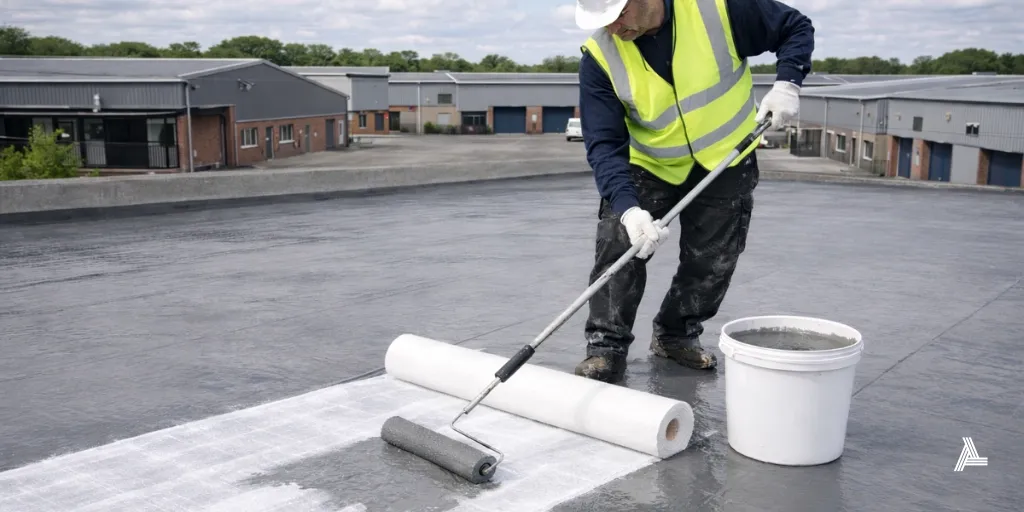
Polyurethane (PU) systems are widely used in refurbishment scenarios. Cold-applied and fully bonded, PU coatings can be installed in multiple layers to build up low spots or gently adjust surface falls. Their elasticity and crack-bridging performance make them well suited to overlaying aged or uneven membranes without the need for structural alteration.
The Allbase Roof Filler System is a lightweight levelling compound designed to address these low spots without the need for full roof replacement or structural alterations. It consists of recycled rubber crumb and polystyrene beads bound with a polyurethane resin, forming a semi-rigid infill that restores a level surface.
The material is applied directly to the affected area over a primed base, then trowelled and shaped to match the surrounding falls. Once cured, it is sealed with a waterproof topcoat to prevent moisture ingress.
For surfaces that remain damp or cannot be fully dried, PMMA (polymethyl methacrylate) systems offer a high-performance alternative. These fast-curing resins can bond to damp substrates and, in some formulations, are capable of curing underwater. PMMA is particularly suited for reactive repairs or projects where weather conditions are unpredictable and drainage cannot be restored immediately.
For localised depressions where lightweight levelling and waterproofing are needed, Allbase has developed a dedicated solution known as PondFix. This innovative product combines polyurethane resin with recycled rubber crumb, polystyrene beads, and a high-performance binding adhesive. The result is a strong yet lightweight compound that can be shaped to reprofile ponding areas and then overcoated with a suitable waterproof membrane. As well as being highly effective, PondFix is an environmentally conscious choice, using recycled materials to reduce waste and environmental impact. Designed for use on both homes and commercial properties, it offers flexibility for a wide range of projects. The system can be applied as a DIY repair by homeowners or specified as part of a professional flat roofing system by contractors.
Each method has its strengths, and the right approach will depend on the condition of the existing roof, the extent of the ponding, and the level of intervention required. When matched correctly to the building and installed by competent professionals, modern liquid waterproofing systems offer long-term protection and restore proper drainage performance across a wide range of flat roofs. Detailing the perimeter correctly, with a raised GRP edge trim that lifts the upstand and directs runoff toward the outlets, keeps water moving rather than pooling at the margins.
Inspection and Prevention
Proper diagnosis is essential before undertaking remedial work, and a roof inspection should be carried out by a qualified contractor or surveyor who can assess the condition of the membrane, check for signs of structural movement, and measure levels to identify where water is collecting. Laser levels, moisture mapping, and core samples may be used to confirm whether insulation is wet or whether the falls are insufficient.
It is important to avoid flood testing as a means of assessing drainage, as it can overload weak points in the membrane and cause water ingress. Instead, inspections should rely on precise measurements and surface condition assessments. Design reviews should also include a check on the number and positioning of outlets, the detailing of outlet collars, and the capacity of the drainage system to cope with typical rainfall for the region. BS EN 12056-3 can be used as a reference for calculating flow rates and ensuring compliance.
Once a ponding issue has been resolved, regular maintenance is essential. Outlets should be kept clear of debris, especially during autumn and after high winds. Roofs should be inspected periodically for new signs of sagging or blockage, particularly after heavy rainfall or freezing conditions.
Conclusion (TLDR)
Ponding water is more than a visual flaw, but a clear sign that the roof is not performing as it should. If ignored, it can compromise the membrane, damage insulation, and weaken the structural deck. In many cases, it also leads to increased maintenance costs and reduced energy efficiency. Addressing it early is the best approach, whether the solution involves a minor surface correction, a new drainage layer, or a full overlay with a modern liquid-applied system, the key is to act before the damage becomes widespread.
It is important to avoid flood testing as a means of assessing drainage, as it can overload weak points in the membrane and cause water ingress. Instead, inspections should rely on precise measurements and surface condition assessments. Design reviews should also include a check on the number and positioning of outlets, the detailing of outlet collars, and the capacity of the drainage system to cope with typical rainfall for the region. BS EN 12056-3 can be used as a reference for calculating flow rates and ensuring compliance.
At Allbase, we offer a complete range of advanced liquid waterproofing systems designed to withstand the UK climate and solve common flat roofing challenges, including ponding water. Our solutions include Polyester, Polyurethane, Polyurea and hybrid systems, and are supported by full technical guidance, specification advice, and long-term guarantees. For a fast, effective and environmentally friendly solution to ponding issues on a flat roof, PondFix offers a unique option for both residential and commercial applications.